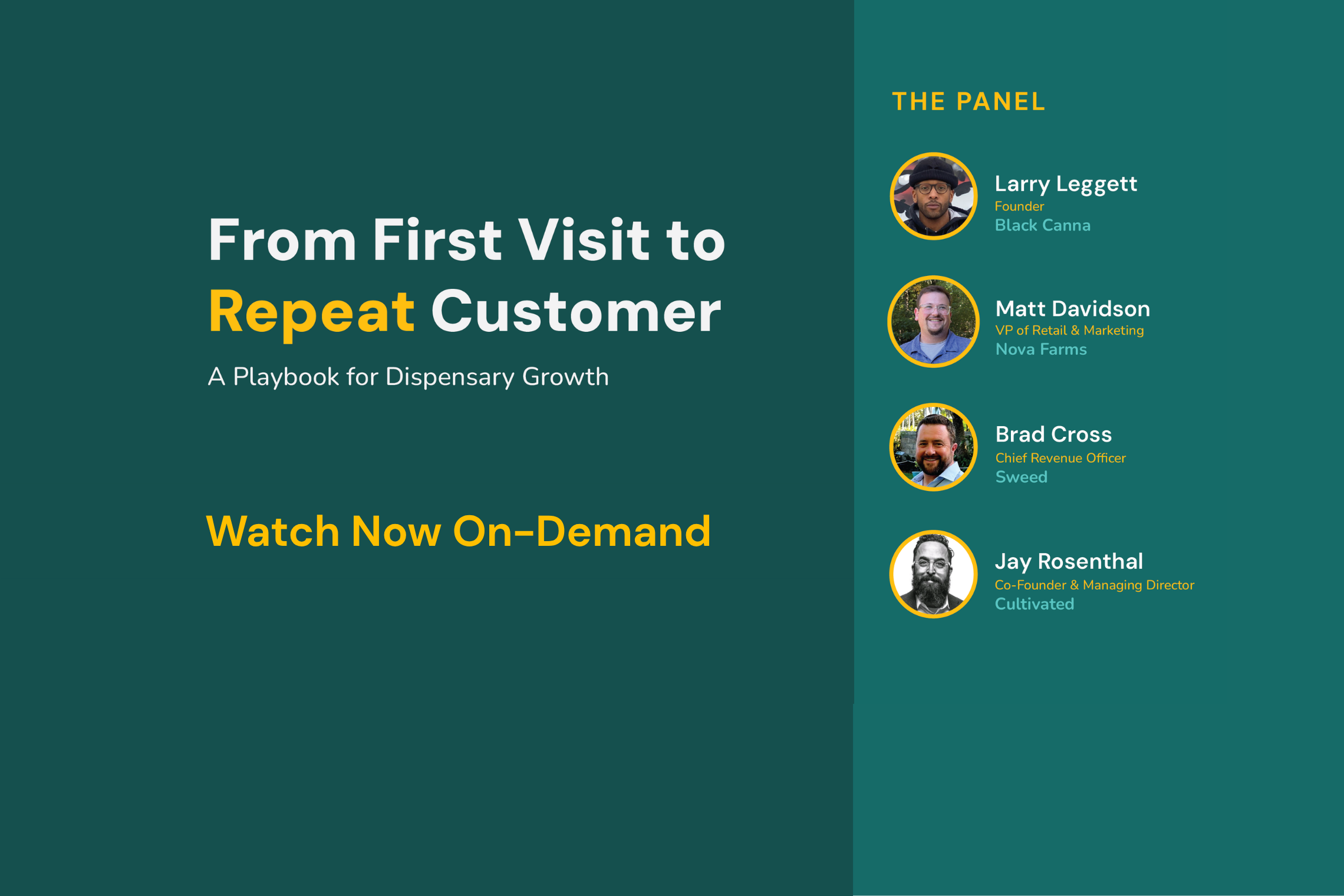
On August 20th, Sweed teamed up with Cultivated for a live conversation about what actually turns a first-time shopper into a loyal customer. The panel brought together operators and strategists who live in this problem every day: Brad Cross (CRO at Sweed) moderated, alongside Jay Rosenthal (Founder and Managing Director at Cultivated), Elliott Rothman (Head of Client Strategy at Sweed), Larry Leggett (Founder of Black Cana), and Matt Davidson (VP of Retail & Marketing at Nova Farms).
The discussion covered a lot of ground, but three themes kept coming up: how customers find you before they ever walk through the door, how actually to measure whether your marketing spend is working, and what separates the dispensaries that build repeat customers from the ones that don’t. Here’s the recap.
Local Visibility Starts Before the Customer Walks In
The panel opened by digging into what actually moves the needle for local visibility. Is it local search ranking? Review volume? The honest answer: it’s both, and they feed each other.
The group broke it down into branded versus non-branded SEO. Non-branded efforts focus on building as much content, awareness, and community engagement as possible, while branded efforts focus on moving closer to the customer through pricing, loyalty, selection, and clear communication. It takes a holistic approach that includes both.
Elliott (Sweed) pointed to store descriptions as one of the biggest missed opportunities outside of the menu itself. His advice:
“Make sure that you’re mentioning the nearby neighborhoods that you serve, unique store features that aren’t check boxes in your Google business profile (ex., RV parking), and nearby businesses and landmarks.”
Larry (Black Canna) added a reminder that’s easy to overlook:
“A lot of people don’t take into account that your SEO is a by-product of the work that your inventory managers are doing too. They’re the ones who are inputting the descriptions and the names. If the naming conventions aren’t right, they aren’t going to be searchable online.”
Reviews Are a Momentum Game
On review volume, the panel emphasized setting up automations and touchpoints that reach customers as they’re walking out the door. Not two days later. And once the reviews come in, reply to all of them, quickly.
Different dispensary chains take different approaches here. Some curate for high ratings, others focus on generating as much review volume as possible, even if a few are negative. The group noted that Google surfaces what it thinks is best for the consumer, but momentum matters just as much as volume: get 1,000 positive reviews in your first week and then go quiet, and Google will stop recommending your store.
Negative reviews aren’t necessarily a red flag either. As the panel put it, it takes more effort to write a positive review than a negative one, so discerning customers tend to recognize that a handful of negative reviews alongside a wave of positive ones aren’t representative of the business. That said, training your team to treat negative reviews as opportunities – not threats – can turn a frustrated customer into a loyal one.
Elliott (Sweed) also flagged a channel that’s easy to underestimate.
“Yelp comes up in Apple Maps, and some of your highest-intent purchases come from Apple Maps, and it skews a lot higher for cannabis dispensaries because when people search “dispensaries near me,” in Apple Maps it’s with the intention of going into the store and buying something.”
Matt (Nova Farms) shared how his team approaches the ask itself:
“We talk a lot with budtenders at the counter about what it takes to ask for a review and ask for it over and over again, because it’s a difficult and uncomfortable situation for a lot of people to ask for feedback on how they’re doing, and it’s a challenge at the counter, but platforms like Sweed are automating the asking portion.”
Larry (Black Canna) summed up why multiple touchpoints matter.
“It’s about multiple touchpoints. You have the budtenders soliciting their reviews, but it’s also important to make it easy for the customer to leave said review. Through automations, text messages, emails, and review cards.”
Your Online Presence Is Your First Retail Touchpoint
One of the most repeated ideas of the session: almost every customer’s first experience with your business happens online, whether that’s Apple Maps or Google Search. Elliott (Sweed) framed it directly:
“It’s really important that you think about your online presence, beyond your website, as the first retail touchpoint; not your digital presence, it’s your whole presence.”
Small things carry weight here. Updating store photos once a year (especially around holidays), and giving every location its own unique description that highlights its neighborhood, unique features, and practical details like bilingual staff or parking. That way, customers walk in already knowing what to expect.
Matt (Nova Farms) described the goal as building a consistent experience at every touchpoint:
“We are trying to make one customer journey, from the time you enter the Google listing until you cash out at the counter. Part of what we’re doing live in the store is to digitize everything.”
Jay (Cultivated) put it simply:
“Ideally customers don’t even think about it – Online and in-store, it’s automatically just there, but also the opposite is jarring. Either the technology, or my product, or look/feel. That’s almost even more jarring, cause it makes you feel like, Am I even in the right place?”
Larry (Black Canna) added a caution about overselling:
“You don’t want to oversell the expectation digitally before they walk through your door. So for example, if you’re a store that just wants to churn and burn customers and get them in and out, don’t talk about your budtenders having a consultative approach and taking the time with customers, because you’re going to set that expectation and that’s what customers are going to look for.”
Which was echoed by Matt (Nova Farms):
“The biggest piece of customer friction you can give them is an unwelcome surprise. As soon as you give them something they’re not expecting, you’ve lost the battle.”
Consistency Separates the Winners
What separates successful stores from less successful ones, even within the same company? Consistency. Matt (Nova Farms) was blunt about it:
“You can’t take a passive approach to having more people enter the doors, creating more content online, and pushing the store through the visibility channel. Where we see the most success is in the consistency level.”
Jay reminded the group that cannabis retail isn’t a “set it and forget it” category. The market shifts constantly, with new stores opening, others closing, new products landing, and consumer behavior changing month to month. What worked in month one won’t necessarily hold by month two, online or in-store.
And SEO isn’t the whole story. The panel also pointed to “boots on the ground” efforts such as farmers’ markets, festivals, and other community touchpoints as ways to reach customers who aren’t finding you digitally in the first place.
Acquiring Customers: What’s Working, What’s Not
When it comes to marketing and advertising ROI, the panel agreed on one core principle: intentionality and measurability. That means moving away from a spray-and-pray approach toward segmented, targeted marketing that meets customers where they are.
Matt (Nova Farms) described where his team is doubling down:
“Where we’ve really invested is in making sure that the digital side is going directly to the consumer that it’s effective for, and figuring out if it worked, and if that consumer has taken that digital communication and turned it into a digital or a store conversion. This includes segmentation, targeted ads, breaking out discounts by shopping demographics.”
Larry (Black Canna) kept it simple:
“If you can’t measure it, we’ve pulled back.”
He also offered a cautionary joke – if a customer has bought edibles twice, don’t just assume they want a flower promotion next. That’s a shortcut, not a strategy. The real move is leveraging customer preference data to guide which promotions and products you actually surface. Elliott (Sweed) added some nuance here too: “There’s a natural cadence to consider, but also room for smart adjacency. For example, someone who buys edibles might also be open to drinks.”
Understanding the Customer Behind the Purchase
Jay (Cultivated) raised a point about relevance and frequency, highlighting the consideration that matters most – relevance, product frequency, what they’re shopping for, and persona:
“If you’re sending me communication once a week and I’ve only been to your store three times and it’s three months apart, that’s almost as irrelevant as giving me a product that I’m not going to buy. It’s important to put some thought into who’s actually coming into your store.”
The panel also touched on something cannabis retail has almost by accident. Because ID checks are a regulatory requirement, operators end up knowing a lot about their customers, which opens the door to smarter personalization. One practical example: Sweed’s ability to notify customers when their ID is about to expire, preventing them from showing up ready to buy only to be turned away.
Elliott (Sweed) tied it back to meeting customers where they are. A new customer might want a budtender’s full attention and product education, while another just wants to get signed up for loyalty rewards and move on. The system needs to be agile enough to handle both.
Measuring Whether a Promotion Actually Worked
How do you know if a promotion is working versus just moving product at a discount? Larry (Black Canna) framed it around velocity – units sold on whatever metric basis you choose – measured against competitors. His example: “If you’re running two vape products at the same discount, that comparison tells you which one to keep.”
The group agreed a discount needs a defined goal to be worth running. As Matt (Nova Farms) put it:
“We only know if a discount is working when we measure it against a specific goal.”
That goal shifts depending on context. Around cannabis holidays and heavy promotional periods, Jay noted that the metric might not be margin at all. It might be about growing your list of contactable customers, even if you lose money on the discounted product itself.
Timing matters too. Cannabis sales tend to peak Thursday through Sunday, so slower early-week days are a natural opportunity to drive traffic. Matt (Nova Farms) shared a stat from his team’s own research: “Day of the week accounts for 37% of sales variability.”
Matt (Nova Farms) broke down what “working really” means:
“If it’s truly a measure of how we increase net revenue, then it’s an average of the transactions we would have seen with or without the discount against what will happen with it. But it’s also essential to be clear on the intentionality of what the goal of the discount is, whether it’s bringing more customers in, increasing cart size, etc. Essentially, there isn’t a universal metric, because there isn’t a universal goal.”
Beyond hard revenue numbers, the panel pointed to softer metrics worth tracking, like click-through rates. And product assortment matters when interpreting results. If you only carry one indica pre-roll and run a promotion on it, the “success” might really just reflect a lack of alternative, not the strength of the offer. Having someone on staff who understands promotion strategy and inventory mix is what turns raw numbers into real insight.
Conversion and Retention: What Actually Wins a Customer
So when does a customer actually convert from first-timer to regular? The panel pointed to the third visit as the tipping point. The point where a relationship and credibility have been established, and where the conversion shifts from discounting toward growing basket size.
But the first visit still carries the most weight. AI and segmentation matter, but there’s a human element that can’t be automated. Elliott (Sweed) laid it out:
“If you can make them feel comfortable, educate them if they want the education, help them make a good selection, and make a solid recommendation, then awesome. If you get them to opt into loyalty, even better because that’s going to create the flywheel.”
One distinction worth sitting with: having customers enrolled in your loyalty program isn’t the same as having loyal customers.
Q&A Highlights
How Do You Decide Which Reviews to Respond to?
The panel agreed that if there’s anything you can do to make an experience right – positive or negative – respond. For negative reviews, going a step further (looking up the customer, having a staff member follow up directly) shows future customers who read that review that you take a proactive approach. And always weigh the response against lifetime customer value. A quick reply now can save a relationship in the long term.
How Do You Keep the In-Store Experience Consistent with High Budtender Turnover?
The panel pushed back on the idea that budtenders are just cashiers, especially as budtenders are required to balance product knowledge, customer relationships, and recommendations that matter to people’s wellbeing. Larry (Black Canna) emphasized treating everyone with integrity, and Elliott (Sweed) shared an example of a dispensary that let budtenders become subject-matter experts in their own right, like a budtender with asthma becoming the go-to expert on cooking with THC. As Elliott (Sweed) put it:
“Budtenders are your front-line; they’re the face of your company, they’re the people who actually interact face-to-face with your shoppers, so it’s essential that you give them all the tools they need to be as effective as possible, while also listening to the budtender feedback directly so you can provide them what they need to be successful.”
Training should also empower budtenders to ask customers why they’re shopping and what they’re looking for, so recommendations don’t default to “whatever’s cheapest.”
What’s the #1 Mistake Operators Make with SEO and New Customer Acquisition?
Look at the data. Look at the keyword opportunities you’re missing, and build real, organic content around what people are actually searching for in your area. One of the most common pitfalls is multi-store operators using a templated store description across every location, which fails to speak to the specific neighborhood and community each store actually serves. Personalizing every description is what attracts the right customers in the first place.


-Cannabis-Retail-Dispensary.svg)
%201.svg)